
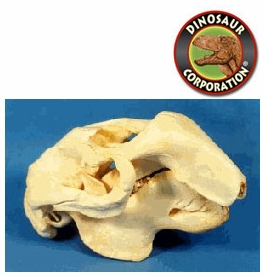

Dugong Skull. Dugong (Dugong dugon) is a large marine mammal which, together with the manatees, is one of four living species of the order Sirenia. It is the only living representative of the once-diverse family Dugongidae.
Like all modern sirenians, the dugong has a fusiform body with no dorsal fin or hindlimbs, instead possessing paddle-like forelimbs used to maneuver itself. It is easily distinguished from the manatees by its fluked, dolphin-like tail, but also possesses a unique skull and teeth.[5] The dugong is heavily dependent on seagrasses for subsistence and is thus restricted to the coastal habitats where they grow, with the largest dugong concentrations typically occurring in wide, shallow, protected areas such as bays, mangrove channels and the lee sides of large inshore islands. Its snout is sharply downturned, an adaptation for grazing and uprooting benthic seagrasses.
Dugongs are generally smaller than manatees (with the exception of the Amazonian Manatee), reaching an average adult length of 2.7 metres (8.9 ft) and weight of 250 to 300 kilograms (550 to 660 lb). An adult's length rarely exceeds 3 m, and females tend to be larger than males.