








Triceratops prorsus
 |
Triceratops prorsus by Josef Moravec. Original oil painting 20" x 16" (51 cm x 41 cm)
* Available for sale to museums and serious art collectors.
* Contact us: Dinosaur Corporation
Triceratops was the most numerous of the horned cretaceous dinosaurs as well as the largest ceratopsian; it was one of the last to become extinct. Its name means "three horned face". Triceratops was a herbivore and its largest predator was Tyrannosaurus rex. It probably ate cycads and all other low-lying plants; it could chew them well with its cheek teeth. These animals probably lived in vast herds and hatched from eggs. They made up the bulk of the herbivore population just before the end of the Cretaceous period. Triceratops had a skull that reached up 6 ft (2m) in length with three protective horns and a great frill of bone that served for muscle attachment to the neck as well as protection from predators. Triceratops had one short horn above its beak and two long, double re-curved brow horns (up to 3 ft/90 cm long). Its head with large eyes was almost one-third as long as its body (up to 10 ft/3 m long) and was the largest ever possessed by a land animal. Its tough beak was toothless, but Triceratops had many cheek teeth and powerful jaws. It walked on all four, short and sturdy legs with hoof-like claws. Its body was bulky and it had a short tail. It also had a thick bumpy hide, prints of which have survived, to protect it against predator attacks, many of which could have come from the fearsome T-rex.
TIME - 70 - 65MYA, Late Cretaceous period
RANGE - USA Montana, N. Dakota, S. Dakota, Colorado, Wyoming Canada-Alberta, Saskatchewan
DIET - Various plants
SIZE - At least 25ft (8m) long
WEIGHT - 2 US tons
*
See more Dinosaurs & Prehistoric Ice Age Animals Oil Paintings in Dinosaur ExhibitsContact us by e-mail to obtain permission for commercial usage of this image: Dinosaur Corporation
© Copyright Dinosaur Corporation, USA. All rights reserved TM
Add Related Items
Recently Viewed Items
 Triceratops prorsus. Cretaceous period. Printed on premium glossy photo paper. Size 8.5" x 11" (21.5 cm x 28 cm). Original oil painting by Josef Moravec. Triceratops is a genus of herbivorous ceratopsid dinosaur that first appeared during the late Maastrichtian stage of the late Cretaceous period, about 68 million years ago in what is now North America. $20.00 |  Triceratops prorsus. Printed on premium photo quality super "B" paper 13" x 19". Original oil painting by Josef Moravec. Triceratops art picture is printed on premium quality glossy photo paper. Triceratops is a genus of herbivorous ceratopsid dinosaur that first appeared during the late Maastrichtian stage of the late Cretaceous period, about 68 million years ago in what is now North America. $80.00 |
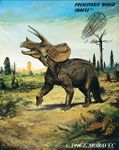 Triceratops from Cretaceous period. Dinosaur Art picture is printed on premium glossy photo paper. 11" x 14". |  Triceratops from Cretaceous period. Triceratops art is printed on high quality glossy photo paper. Size: 17" x 22". Triceratops is a genus of herbivorous ceratopsid dinosaur that first appeared during the late Maastrichtian stage of the late Cretaceous period, about 68 million years ago in what is now North America. $120.00 |
 Triceratops prorsus in photographic quality reproduction Printed on high quality glossy paper. Original art by Czech artist Josef Moravec. |